


Bangor and Aroostook Railroad Pier, Searsport, ca. 1965
Oakfield Historical Society
Maine and the Environment
During the 1970s Maine moved to the forefront among states in environmental legislation. Galvanized by pressure from sports enthusiasts, resort proprietors, coastal and riverside residents, and business leaders, the Curtis administration stiffened Maine's antipollution laws in 1969 and 1970, making the new Environmental Improvement Commission one of the most powerful agencies in the state.
Maine's paper mills spent millions of dollars on technology for waste recovery and recycling, reducing the pollution load by about 90 percent over the decade. The Androscoggin River, once among the most polluted in the nation, sported bass and brown trout at the end of the century.
In addition, Maine took on a broader spectrum of environmental issues, including proposals for oil tanker-ports and oil refineries in Portland, Searsport, Eastport, and Machiasport. While none came to fruition, the fierce debates helped consolidate an environmental constituency and raise awareness of the Maine coast as a national icon. A number of pieces of legislation aided these efforts.

Sketch of country toward the St. John River, ca. 1841
Maine Historical Society
A 1976 referendum, passed by a 60 percent margin despite a huge media blitz by opponents, established a Returnable Beverage Container Law. Expanded in 1989, it gave Maine one of the most comprehensive bottle bills in the nation.
Another focus of environmental concern was protecting the wilderness quality of the northern and western forest lands, the gravest threat being a hydroelectric dam proposal for the pristine St. John River. The Dickey dam, an earth-fill structure more than two miles long and higher than the Hoover Dam, was to be coupled with a smaller re-regulating dam at Lincoln School.
Announced in 1963 as the largest public works undertaking in New England history, Dickey-Lincoln would have eliminated 267 miles of free-flowing streams on the St. John drainage, along with 30 lakes and ponds and 76,000 acres of forest.
In 1976 surveyors found a rare snapdragon known as the Furbish lousewort growing in the reservoir area, and environmentalists nominated the plant for the Endangered Species list. With this issue hanging over the project, opponents challenged the dam's cost-benefit analysis and stressed the issue of Maine sovereignty, since much of the power would have been exported to southern New England.
With pressure from paper companies concerned about their timberlands, from private utilities companies worried about a competing public power project, and from the Sportsman's Alliance of Maine, the Chamber of Commerce, the League of Women Voters, and numerous conservation organizations, prospects for the dam grew dim. In 1983 Congress quietly de-authorized the dam.

Katahdin from Golden Road, 1987
Baxter State Park
The controversy over Dickey-Lincoln triggered a movement to save the nearby Allagash River from logging, dams, and development. Rejecting an ambitious plan to create a new national park along the river, state legislators established the Allagash Wilderness Waterway in 1966, and in 1968 the 90-mile section was included as a state-administered unit in the National Wild and Scenic River System.
These debates drew attention to Maine's north woods, a 10-million acre privately owned but undeveloped tract comprising about half the state.
With a nationwide boom in second-home construction, the woods seemed at risk, and in 1969 the legislature mandated a comprehensive land-use plan for the territory, resulting in creation of the Land Use Regulation Commission in 1971. In 1976, it issued a comprehensive land-use plan that followed four premises: that the area's wild character would be preserved; that the woods would serve multiple uses for timber harvesting, recreation, and habitat protection; that there would be limits on population growth and development; and that most new development would occur in or near areas where development already existed.
Elsewhere, the paper industry accommodated recreational use by providing public access to company lands and offering long-term camp leases on lakes and rivers. Maine had divested its public lands in the 19th century, and with an established tradition of public access to private timberlands, few saw the need for public ownership.
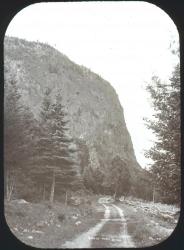
Road to Pebble Beach, Mt. Kineo, ca. 1900
Maine Historical Society
But with recreational use on the rise, company officials worked with state and private conservation organizations to provide easements that would sort out potentially conflicting uses. By the 1990s land ownerships were changing at a dizzying rate, bringing the threat of liquidation or conversion of timberlands to second-home subdivisions.
In 1981 after a long court battle, the state regained control over thousands of acres of wild lands, and a land swap resulted in Maine owning some large and spectacular wilderness tracts. In 1987 Maine citizens approved by referendum a $35 million bond issue for land-acquisition and created a Land for Maine's Future Board.
The agency purchased Mount Kineo on Moosehead Lake and a section of the Downeast "Bold Coast" in Cutler. With additional bond issues in 1991, 1999, 2005, and 2007, the agency spent a total of $72 million to conserve 445,000 acres of forests, waterfronts, and mountaintops.
Maine people found even greater room for agreement in a long-standing project to restore migratory fish, particularly salmon, to the state's rivers. In 1948 the Maine Atlantic Sea Run Salmon Commission was founded in cooperation with the Department of Inland Fish and Game, the Department of Sea and Shore Fisheries, the University of Maine, and the U.S. Bureau of Sport Fisheries and Wildlife.
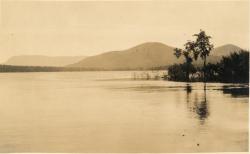
Lobster Lake, 1911
Maine Historical Society
After surveying the stocks of wild salmon, principally in the Penobscot and eastern rivers, the commission prepared to add fishways to the lower Penobscot dams and work progressively upriver as they gauged how salmon dealt with the still-polluted waters.
The effort to restore migratory fish received a boost in 1997 when the Edwards Dam in Augusta became the first in history to have its license renewal refused by the Federal Energy Regulatory Commission, because its environmental costs outweighed its economic benefits.
In a historic settlement between state and federal agencies and private businesses, the Edwards Dam was removed in 1999. Subsequent years saw dramatic increases in sea-run and resident fish and in osprey, bald eagles, heron, cormorants, and kingfishers.
A similar restoration project on the Penobscot River was undertaken with the Penobscot Indian Nation, American Rivers, Maine Audubon, Natural Resources Council of Maine, and Trout Unlimited to form the Penobscot River Restoration Trust in 2005. The migratory fish restoration project, like other aspects of Maine's environmental movement, reflected a strong commitment to forging ahead economically while preserving the best of Maine's past.

Lobster Country, Mount Desert Island, ca. 1980
Jesup Memorial Library
Encouraged by the state's heavy reliance on tourism, its aura of "unspoiled" landscapes, and its attachment to an ill-defined but evocative "Maine Way of Life," these environmental campaigns succeeded because Maine's commitment to the protecting its values was bipartisan, and because Maine people supported a vibrant tradition of grass-roots activism.
Innovations in health, education, and the alleviation of poverty, new developments in arts, crafts, and agriculture, a strong civil rights record, and a nationally acclaimed environmental program – together these aspects of Maine's history reflect a responsive and inventive approach to preserving the past and working toward the future.


