

Maine's mid-coast was particularly attractive, offering fertile soil, low property values, and a scattering of operating farms to provide support, advice, and jobs for the newcomers, whose aspirations – peace of mind, self-reliance, autonomy, harmony with land, and hard work – were not all that different from traditional Maine values.
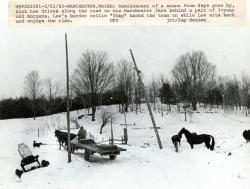
Farmer and dog, Manchester, 1982
Maine Historical Society
The back-to-the-land movement put Maine in the forefront of a rapidly growing trend in producing food without chemicals. Rachel Carson's best-selling Silent Spring (1962) raised awareness of problems such as soil and water toxicity and chemical residuals in foods, and in the 1970s doctors found traces of dangerous chemicals in human tissue.
Responding to these concerns, organic farmers grew vegetables, fruits, berries, poultry, and livestock and produced baked products, fabrics, preserves, greenhouse plants, and other niche commodities, which they sold directly through roadside stands and farmers' markets or in health-food stores.
In 1970 farmers interested in organic products began meeting around the state and formed the Maine Organic Foods Association. In 1972 the re-named Maine Organic Farmers and Gardeners Association announced Maine's first certified organic farm: the 140-acre Ken-Ro Farm in Plymouth. With reliable and consistent labeling and certification, the industry expanded into chain supermarkets.

Loading sugar beets, Aroostook County, ca. 1975
Oakfield Historical Society
About a quarter of Maine's traditional farmers began experimenting with crop diversification and rotation to stabilize income and reduce the need for pesticides and fertilizers. The 1970s also brought a revival of part-time "values" farming, as families frustrated with urban life and enticed by improved country roads chose to live on a farm and commute to work.
Like farmers since Maine's beginnings, they gained a sense of independence by making do with less – in this case, less machinery, government support, and marketing intermediaries.
These developments helped reverse a long downward trend in the number of Maine farms, which dropped to 6,800 in 1975 then increased 20 percent over the next two decades.
Remaining traditional farms tended toward highly mechanized operations specializing in potatoes for chips and frozen-food packages, poultry and eggs, dairy products, apples, blueberries, or cattle.
High entrance costs, long and difficult work-days, smaller families, and a rising number of rural women holding non-farm jobs impinged on the family farm; at the end of the century only a third of Maine farms had been owned successively by two generations of the same family. For those farming near cities, suburban development brought conflicts over early morning mechanical noise, fertilizer smells, and pesticide drift.

Blueberry Cannery, Brooklin, ca. 1933
Sedgwick-Brooklin Historical Society
While farmland in Maine declined from 1.5 million acres in 1950 to fewer than 600,000 acres in 1990, suburban land nearly doubled to approximately 1.2 million acres. Here again Maine's appealing pastoral image encouraged a demographic drift to the countryside, encouraged by improved roads, rising city taxes, and mortgage interest tax deductions and other federal housing incentives. At the same time, older cities and towns were saddled with underused service infrastructure.
Maine's new post-industrial status also stimulated interest in Portland's long-neglected waterfront district. In the 1970s Americans rediscovered older city districts left behind in the rush to build towers of concrete, steel, and glass, and city planners took advantage of federal redevelopment and revitalization programs and new public transit systems to reconfigure these intimate old neighborhoods as regional-theme open-air shopping districts. Portland's Fore-Street neighborhood had been colonized in the 1970s by artists, craftspeople, and start-up entrepreneurs seeking cheaper rent.
Aware of waterfront developments elsewhere, real estate investors organized the Old Port Association and encouraged the city to repair the sidewalks, install street lights, plant trees, and build parking garages.

Middle and Exchange streets, Portland, 1988
Maine Historical Society
In 1977 the city issued bonds to build the Cumberland County Civic Center on the edge of the district, and with tax incentives and federal grants, builders transformed the old houses, apartment buildings, brick commercial buildings, and warehouses into a romantic archetype of the old New England seaport, with cobble streets, boutiques, bakeries, arts-and-craft shops, pubs, and specialty restaurants. Augusta and Bangor followed suit with somewhat less ambitious waterfront plans.
Remote areas of Maine saw similar post-industrial development when ski resort complexes at Sugarloaf, Saddleback, and Sunday River expanded into all-season recreation and leisure accommodations, bringing tourist development in the form of inns, condominiums, golf links, motels, restaurants, night spots, A-frames, lodges, and clothing and equipment shops at the resorts or in nearby towns like Kingfield, Rangeley, and Bethel.


