

Lobster was the state's premier example of sound fishing strategies, with landings rising from a postwar 20 million pounds to a historic high of 60 million pounds at the end of the century. Among other factors, the increase was due to sound conservation practices and, after 1997, local governance through designated lobster zones. Other inshore fisheries – groundfish, sea urchins, and herring – were less successful.
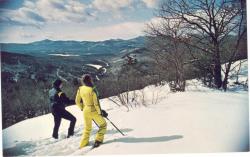
Evergreen Valley Resort, Stoneham, ca. 1970
Lovell Historical Society
Maine's recovery was most evident in what came to be termed the "creative economy": a mix of small, leading-edge technical and communications businesses coupled with a flourishing arts, crafts, cultural, and environmental tourism scene.
At the turn of the century organizations like Greater Portland Landmarks, Mountain Counties Heritage Network, and the Down East Heritage Center added new points of attraction to the tourist landscape, and better hiking, biking, and cross-country skiing trails with huts, lodges, and other facilities signaled the potential for eco- and heritage tourism, as did walking and driving tours, guides to Maine crafts and culture, the Maine Island Trail, the Maine Landscape Garden Trail, and the Northern Forest Canoe Trail.
Transportation such as the Downeaster rail connection to Boston, the Mount Desert Island Explorer bus, and stops for ocean liners in Portland, Bar Harbor, and Bangor also helped broaden the tourist base. The yearly Common Ground Fair in Unity and American Folk Festival in Bangor attracted thousands of visitors and enhanced Maine's cultural image.
While jobs in tourism remained among the lowest paid in the Maine economy, the new creative economy offered business opportunities in recreational instruction, arts and crafts, and services.

Potato blockade, Fort Fairfield, 1980
Maine Historical Society
Maine's economy melded almost imperceptibly with regional and national trends, but persistent problems in rural districts back from the I-95 Corridor gave poverty a somewhat distinctive cast in the "other" Maine.
Rural poverty, characterized by low wages, part-time and seasonal jobs, frequent layoffs, and the need to work two or three jobs to stay afloat, rose from 13 percent of the population in the 1970s to 16 percent in the early 1980s due to rising rents and utility rates, stagnant rural industries, and the loss of unionized manufacturing jobs.
The most dramatic change in the nature of poverty was the growing number of working poor, single mothers, and elderly on fixed incomes.
Maine Pastoralism: The Way Life Should Be?
Maine's long textile recession had buffered the state from the economic growth pains experienced elsewhere in the nation, and in the last third of the 19th century, Americans embraced the idea of open or pastoral landscapes as a spiritual refuge from urban society.

Portland Head Light, ca. 1935
Maine Historical Society
Infused with rich pastoral imagery by writers like Henry Beston, Robert P. Tristram Coffin, Ruth Moore, Mary Ellen Chase, and Sarah Orne Jewett, the coast experienced a real-estate boom that highlighted this new post-industrial significance.
In a 1970 newspaper article, commentator Bob Cummings pointed out that only 1.4 percent of Maine's 3,000 mile coast was in public hands, while several million metropolitan residents lived within a day's drive of this choice waterfront property.
Maine's new pastoral status attracted a generation of young, well-educated in-migrants seeking safe towns, inexpensive real estate, lower property taxes, and human-scale neighborhoods. In general terms, they were interested in a higher quality of life, an important consideration in a society wracked by war, civil protest, urban crises, and dissatisfaction with consumerism. The state still saw a net outflow of post-high-school age youth, but the counter-flow more than compensated.
In the mid-1970s Maine gained 36,000 new citizens per year and lost 30,000 to out-migration. With births exceeding deaths, Maine population grew steadily, putting pressure on the state's educational system and other services. Migrants also included a smaller stream of African-Americans, Asians, and Hispanics, although overseas migration remained limited.

Fore River, Portland, 1988
Maine Historical Society
Newcomers settled largely in southern Maine, and primarily in small and medium-sized towns. Almost half were from other New England states, with 22 percent from Massachusetts. Most were young with relatively small families, and nearly 43 percent had completed at least four years of college.
Maine's attractiveness was also evident in a pronounced "back to the land" migration. A revival of small-scale family farming, the new homesteading, as it was sometimes called, was fueled by a romantic idealization of the Maine countryside, a Jeffersonian ideology updated by small-farm advocates like Wendell Berry, and by magazines like Mother Earth News.
Helen and Scott Nearing, who spent nearly a half-century on subsistence farms in Jamaica, Vermont, and Harborside, Maine, exemplified this spirit in their many publications, including Living the Good Life (1954) and Continuing the Good Life (1979). Stressing independence, organic living, and a balanced regimen of hard work and leisurely contemplation, they appealed to a generation jaded by urban life and consumer capitalism.


