


Stairs-Beckwith Farm, Presque Isle, ca. 1950
Presque Isle Historical Society
Dairy farmers expanded during the post-war era, investing in milking machines, antibiotics, artificial insemination, and scientifically designed feed rations as the average dairy operation increased from 20 to over 80 cows.
Those who invested in this new technology sometimes saw production outstrip demand when others did the same, reducing profits in the long run – a classic "technology treadmill." This cycle hurt small and middle-sized farms particularly, contributing to the decline in farms, farmers, and land under cultivation, even while capitalization and productivity per acre increased.
Maine farmers gained much from this agricultural revolution, in living standards and release from the drudgery of farm and domestic work. But they also created a rural landscape far different from the familiar town-and-country setting they knew before the war.
In the first half of the century, farms had been to a greater extent self-contained, providing their own seed, fertilizer, horsepower, and wood for construction, tools, and heating. They sold their product to local co-ops or merchants and took their timber, hides, corn, grains, and dairy products to local processors. The rural community in turn provided schools, churches, fairs, grange halls, professional offices, stores, shops, banks, building-supply outlets, and coal depots.

Route 201, Topsham, ca. 1955
Pejepscot History Center
In the decades after 1945 farmers met their needs through metropolitan banks, national commodity dealers, giant farm equipment and supply corporations, and vertically integrated food conglomerates, and small towns lost much of their social and economic salience.
Some survived as regional trade centers, but others were swallowed up by suburban expansion or lapsed into economic and social decay. Trends in farming helped shape the economic geography of the "Two Maines."
Maine's "Little Great Depression"
Maine's industrial landscape was likewise a mix of growth and stagnation. Job losses in older industries producing lumber, fish, quarry products, textiles, and leather encouraged out-migration, and this in turn skewed the state's demographic structure toward those too young or too old to contribute to the workforce.
This demographic profile reduced Maine's tax base and strained its social services, further slowing the transition to a new, more competitive economy. These demographic and economic feedback loops contributed to what some called Maine's "Little Great Depression."
The paper industry, controlling about 80 percent of Maine's commercial forest and a quarter of its manufacturing workforce, and the defense industry, predicated on shipbuilding at Bath Iron Works and the Portsmouth Naval Shipyard and military bases at Limestone, Brunswick, Bangor, and Presque Isle, were important exceptions to the general malaise, providing high-paying jobs and steady growth. After World War II shoe production shifted into "stylish up-to-the-minute shoes" and remained steady despite low wages.

Weave Room, Worumbo Mill, ca. 1950
Lisbon Historical Society
Cotton textile mills were the most important ingredient in Maine's industrial depression. The First Boston Corporation acquired five mills from New England Public Service Co. in 1945 and modernized the equipment. Between l945 and l95l Bates Manufacturing in Lewiston spent another $11 million on improvements and expansion, becoming the largest employer in the state.
Still, mills in the American South and postwar Japan had enormous advantage in newer technology, larger physical plants, and cheaper labor, and by 1953 Maine's mills were losing orders and changing owners with disconcerting frequency. In 1954 alone Maine lost 2,000 textile jobs, and New England, 25,000.
Bates Manufacturing responded by shifting to high-quality bedspreads, and the Androscoggin Division, with l,850 looms, moved into synthetic fabrics. When several other New England mills were shuttered, those in Maine picked up their contracts, but stability merely drew in outside financiers interested in short-term profits.
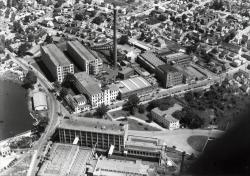
Goodall Worsted Company, Sanford, 1934–1939
Sanford-Springvale Historical Society
Goodall-Sanford Industries passed into the hands of the Burlington Mills Company from South Carolina, which promptly closed several mills and narrowed the product line. In l955 New York financier Lester Martin moved to acquire several other Maine mills, and in response, Bates officials and others lobbied to amend the company charter to prevent the takeover. When the bill failed passage, Martin gained control, closed several mills, and laid off nearly l,000 workers.
In 1955 the U.S. Department of Labor named Sanford and Biddeford top priority distress areas and offered a preference in bidding on government contracts.
Mill-town officials acquired vacant buildings, leased space to new businesses, and set aside industrial parks. Lewiston created an Industrial Development Department to advertise the state's "Industrial Heartland."
Over the next two decades the city attracted several businesses producing light, high-value electronic goods like instrument components, semiconductor transistors, and telephones. In some cases these industries proved ephemeral, but they set Maine on a path toward diversified light manufacturing.
By this time, however, the shoe industry was falling on hard times. Maine's emergence from depression conditions was still years away.


