


Katahdin from the mouth of Abol, ca. 1900
Maine Historical Society
As with Maine tourism generally, the town capitalized on its reputation for health – pure salt air, bracing ocean waters, and a tradition of "taking the waters" on St. John the Baptist Day, June 24, as a ritual of purification –– to appeal to urbanites troubled by sanitation problems in their city environments.
Tourism brought a new orientation to Maine state government. In the 1870s the Maine Commissioner of Fisheries, created in 1867, shifted its focus from protecting commercial river fisheries to stocking inland game fish like landlocked salmon and trout. Game conservation began at about the same time, although this proved too late to save Maine's migratory caribou herds, which disappeared about 1907.
As automobile tourists replaced the more sedentary grand hotel visitors, Maine embarked on a "Good Roads" program, establishing a state highway commission in 1905. The Maine Bureau of Information, funded principally by the state's hotel proprietors, was replaced by the Maine Publicity Bureau in 1922 and began receiving limited state funding a few years later.
Maine's Small Industries
Alongside large-scale manufacturers of paper, shoes, textiles, and granite, Maine produced a dizzying array of smaller items that sustained a significant portion of its economy. At the turn of the century Maine's landscape was dotted with small sawmills, furniture factories, woolen mills, stone cutting sheds, lime kilns, excelsior mills, peg and shank mills, slate sheds, wood novelty mills, canneries, tanneries, spool and bobbin mills, machine shops, toothpick factories, shingle mills, boat shops, and veneer mills – an economy still vibrant despite the forces that drew Maine's natural and human energies to industrial towns like Rumford, Lewiston, and Millinocket.

Maine Spinning Company mill, Skowhegan, ca. 1925
Skowhegan History House
In 1901 alone, Somerset County in northern Maine gained two small sawmills, two pulp mills, a paper mill, a furniture factory, a wood novelty mill, a clothing factory, a cannery, a shovel handle factory, and two birch spool and bobbin mills.
The upland town of Dover-Foxcroft contained a small woolen mill, a furniture manufacturer, a butter factory serving nearby summer resorts, and a carriage and sleigh shop, along with several clothing manufacturers, brick yards, blacksmith shops, dye works, foundries, machine shops, and lumber, shingle, novelty, and grist mills.
It was evident, the Portland Board of Trade noted, that Maine's prosperity depended "in a large measure upon ... these little centres of industry and trade which supply to such a large degree the commercial advancement of the leading cities of our State."
Wood novelty shops were typical of these small rural industries. They stayed in business by using cheap local materials – often discards from a nearby lumber mill – to make a broad array of small products like toothpicks, checkers, dice or domino boxes, backgammon boards, wooden bicycle rims, tables, desks, sleds, swings, toys, or Christmas ornaments.

Twine Mill, West Kennebunk, ca. 1880
Kennebunk Free Library
Between 20 and 40 such mills dotted the upland landscape, consuming in the aggregate enormous quantities of wood. One manufacturer made 50 different novelties, noting that it was "by such combinations that large profits are made."
Survival in these small industries depended on access to cheap local materials, a low overhead investment in light machinery, flexibility, and an adaptive ingenuity – in short, the capacity for quick retooling to meet the shifting needs and fashions of the rapidly evolving 20th-century market.
This small-scale rural economy was both traditional and modern, representing the fragments and shards of Maine's traditional resource-based industries and a local orientation in supplies, knowledge, and labor. But as railroads snaked their way into these interior towns, these small manufacturers responded readily to national markets.
Farms, too, existed in a world between the new and the old. Between 1870 and 1920 the number of Maine farms dropped from 60,000 to 40,000, but families on more than half those remaining grew their own food, cut their own wood, and practiced diversified farming, as they had since colonial times. Farms gradually focused their activities on commercial crops, but remained small, diversified, and flexible.

Main and State Streets, Presque Isle, 1910
Presque Isle Historical Society
Here too, rural Maine met the challenge of modernity by spreading its activities laterally along the changing loci of opportunity. The characteristics that defined early 19th-century rural society – wide distribution of property, diversified, semi-subsistence agriculture, small-scale manufacturing, and local exchange of goods and services – were still powerful cultural determinants at the end of the century.
In an age of shifting markets and shifting values – new forms of spending and leisure, installment buying, mass consumption – Maine's "island communities," each with its own idioms and particularized culture – were still intact. There was, in fact, considerable substance to Maine's image as a "state of villages and small cities, largely aloof from the mighty currents of industrial and urban life, largely homogeneous, traditionally Republican, and devoted to the immortal principle of the 'Maine Law [temperance],'" as a New York Times correspondent phrased it.
These farms and small industries faced enormous pressures at the end of the century. Many shut down when markets dried up or the family patriarch retired.
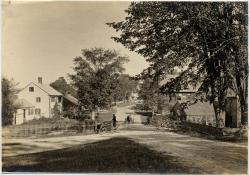
West New Portland Village, ca. 1905
Stanley Museum
There were, as Mark Walker illustrates in his reminiscences about "growing up poor in the Kennebec Valley," examples of communities wholly decimated by the loss of two or three farms or small manufacturers.
"The transformation of New Portland from a thriving commercial center to a stagnant backwater was symptomatic of the sickness of the whole region," he wrote of his boyhood in the 1920s, when some 40,000 men and women with skills, judgment, and a willingness to work left the countryside for better opportunities elsewhere.
Stretched between the old and the new, life was precarious indeed, but even under these enormous pressures, small towns were a vital force in Maine society.


