

Cultural Expressions
Maine's natural attractions and location have inspired artists and writers as well as outdoors enthusiasts. But cultural expressions in the state go beyond writers and artists to include theater, dance, music, and more. Cultural institutions have been found in communities of all sizes across the state.

Julia, and the Illuminated Baron, Portsmouth, New Hampshire, 1800
Abplanalp Library, UNE
Sally Sayward Barrell Keating Wood (1759-1855) became Maine's first novelist when she published Julia and the Illuminated Baron in 1800. A widow with three children, she wrote five novels for which she received acclaim, although the books were published anonymously.
Known as Madam Wood, she became active in Wiscasset community life after her second marriage, to Gen. Abiel Wood.
She is followed by innumerable novelists, poets, playwrights, essayists, journalists and other writers – some of whom write about places and people distant, some based closer to home and reflecting the values and physical surroundings of the state.
Some of Maine's best-known writers have focused on their home state, at least to some degree. Sarah Orne Jewett (1801-1887) captured the sense of small towns and especially the women in them. Gladys Hasty Carroll (1919-1999) wrote about farm life in Maine and the pull of a more urban existence in As the Earth Turns.

Stephen King, Bangor, 1982
Maine Historical Society
Kenneth Roberts (1885-1957) wrote historical novels, many of which focused on Maine and New England. Stephen King (1947- ), one of Maine's most prolific authors, has set some of his novels in Maine, but his appeal and his settings have gone far beyond the state's borders.
There are many more writers whose works or whose lives have become connected to Maine and helped create Maine's identity. Part of that identity is as a state where arts and artists are integral to the life of many communities, where individualism and individual expression are encouraged, and where residents and visitors help support artistic endeavors.
Visual artists such as John Brewster Jr., Frederic Mellen, Andrew Wyeth, Rockwell Kent, John Marin, Franklin Simmons, Rufus Porter, Marguerite and William Zorach, Dahlov Ipcar, Berenice Abbott, and Marsden Hartley have worked and thrived in Maine.

Charles Woodbury, Ogunquit, 1937
Maine Historical Society
Especially those artists who have used Maine's landscapes and people to inspire their work have spread an image of the state, sometimes romanticized, that has helped draw others or fixed a particular idea about Maine – the rugged coast, the woods, rural communities – in the imagination.
Artists' colonies that began in the late 19th century, most notably in Ogunquit and Monhegan Island, furthered the visual image of Maine. Artists painted homes, people, and seascapes, capturing not only the scenery of Maine, but also the light, and the way of life along Maine's long Atlantic coastline.
Towns often sought to affirm their cultural identities by building music, art, historical, and theater venues and forming organizations to promote the arts. Some institutions were launched in the late 18th century, but many formed during the more prosperous 19th century.
Many of the first cultural institutions were situated in Portland: a theater, which opened in 1794, and Columbian Hall, which hosted a variety of popular attractions early in the 19th century (including "Old Bet," the elephant), were among them.
In Madison, the Lakewood Theater opened in 1898, one of the many attractions built by trolley companies to promote ridership on their lines. Lakewood has the distinction of being the oldest summer stock theater in the U.S. At other trolley parks, in Portland, Cape Elizabeth, Brunswick, and many other locations, music and theater flourished.

Opera House and Hotel, Presque Isle, ca. 1900
Aroostook County Historical and Art Museum
In towns throughout the state, community bands that formed in the 19th century and sometimes went off to war also served as entertainment at town events and as venues for teaching music, mostly to young boys. Portland's Rossini Club began in 1869 as a women's musical society. The New England Music Camp in Sidney opened in 1937.
Towns of all sizes built opera houses at the end of the 19th century. The Camden Opera House, for example, built in 1894 and once the tallest building in Knox County, hosted operas, town meetings, and other community events. When moving pictures arrived, it hosted those, too.
George Adams, who designed and built opera houses throughout northern New England, built the Waterville Opera House on the second floor of the city hall.
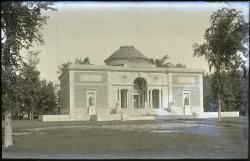
Walker Art Building, Bowdoin College, Brunswick, ca. 1910
Maine Historical Society
In 1894, Bowdoin College completed work on its Museum of Art, although its collection of painting and other works had been growing since 1811. Each of Maine's major universities has an art museum, many created in the mid 20th century.
The Portland Society of Art, which formed in 1882, split into the Portland Museum of Art and the Portland School of Art (later Maine College of Art). Both have long been focal points for teaching and exhibiting art in southern Maine.
The Abbe Museum opened in Bar Harbor in 1928. It was the first institution in Maine to sponsor archaeological research and has a large collection of Maine archaeological materials and Wabanaki art, especially baskets.
Dozens of other museums, galleries, community theater companies, musical ensembles and orchestras, many with long histories, are part of large and small communities across the state.

Abbe Museum, Sieur de Monts, Bar Harbor, ca. 1970
Jesup Memorial Library
Summer institutes like the Stonecoast Writers Conference at Freeport, the Skowhegan School of Painting and Sculpture, the Haystack Mountain School of Crafts on Deer Isle, the Bowdoin International Music Festival, and the Bates College Dance Festival each gained wide renown for the quality of their staff and programs.
Indeed, the arts and humanities and their related institutions have brought such vibrancy to communities that, even amidst the economic and industrial decline of the last century, an impressive number and variety of cultural structures were built, and institutions organized, across the state.


