

Immigration in Large Numbers

Regina Carrier, Mary Ann Vachon, Biddeford, 1927
Maine Historical Society/MaineToday Media
The largest numbers of 19th century immigrants came from Canada and came at a time when industry provided job opportunities in the United States and farms and small communities in Quebec and New Brunswick offered lives of struggle to many residents.
In addition, a fluctuating border along the St. John and St. Croix Rivers had stranded relatives on both sides for decades; many French Canadians came to join their American kin.
Overwhelmingly of French Canadian origin, as much as 75 percent of the population in some northern and eastern sections of the state were either foreign-born or first generation American by 1910. Most of these Franco-Americans populated rural areas in northern towns and border communities, accounting for a 50 percent increase in Aroostook county population between 1900 and 1910, or moved to mill towns like Lewiston-Auburn, Waterville, Biddeford, Rumford, and Sanford, among others.
At the same time, events like the Irish Potato Famine of 1845-1852 drove many thousands of Irish men and women to the United States, including Maine. Irish immigrants settled in many communities, working in mills, on the waterfront, on construction projects and other concerns.

Michael Dailey naturalization certificate, Portland, 1868
Maine Historical Society
While the first French and Roman Catholic presence in Maine was recorded in early Colonial days, the early 19th century immigrants solidified both connections. New Roman Catholic parishes sprang up throughout the state, with French-Canadians and Irish building separate churches and separate communities. Parochial schools taught French-Canadian children in French, at least for part of each day, helping to preserve more than religious traditions.
Even though the earliest French explorers and settlers in Maine brought Roman Catholicism to the state, and converted many Indians, the dominant religion in the state was Protestant, and discrimination on religious grounds, among other reasons, affected both the French-Canadians and the Irish immigrants.
The height of Protestant, nativist sentiment was during the years after World War I when the Know-Nothing party and the Ku Klux Klan were active in anti-immigrant and anti-Catholic activities, complete with very public rallies, women's auxiliaries, and cross burnings.
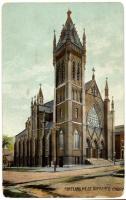
St. Dominic's Church, Portland, ca. 1913
Maine Historical Society
Protests against their arrival aside, European immigrants added their skills and traditions to Maine society, many arriving in the post-Civil War years of industrial expansion that continued well into the 20th century. Irish immigrants contributed to the growth of urban industries in places like Portland, Lewiston, Auburn, and Biddeford that helped fuel national economic and industrial prowess following the Civil War.
Many single Irish women came to Portland and other communities, in both the pre and post Civil War waves of Irish immigration. They worked as domestics, one of the few jobs open to them, and in fish canneries and other industries, as well as in tourism, especially in hotels and restaurants. Irish and other nuns through their religious orders offered educational opportunities not otherwise available to immigrant women.

Finnish Church confirmation class, South Thomaston, 1933
Maine Historical Society
Other immigrant groups came as well, driven out of their homelands by poor economic conditions and drawn by potential opportunities and, often, relatives in Maine. Finns left difficult economic times in their country in the last quarter of the 19th century, many coming to Maine to work in the granite and slate industries.
Chinese immigrants came, in relatively small numbers, but were spread across Maine by the 1920s. Many had gone first to the west coast and found their way east. Restaurants, laundries and other businesses bore the name of Chinese entrepreneurs.
Italians joined the Finns in granite quarries, and moved to Portland and other cities where they worked in construction, among other jobs.
Promoting, Discouraging Immigration
The Swedish migration to Aroostook County offers an interesting example of late 19th century thinking about immigration. William Widgery Thomas, a Bowdoin College graduate, spent three years as a consul to Sweden. His job was to promote immigration to the U.S.

New Sweden 40th Anniversary, New Sweden, 1910
University of Maine at Presque Isle Library
Thomas believed Swedes were the perfect immigrants to help populate Aroostook County – and keep less desirable immigrants from settling there. He saw the Swedes as hard working, pious and suited to the climate. Thomas screened the applicants for immigration to insure they were appropriate.
Swedish immigrants, who began arriving in 1870, received tax-free land to establish their farms. By 1873, 600 Swedish immigrants had built 130 homes and barns and cleared 1,500 acres for their farms.
The official sanction to immigrate suggests one way in which public policy, laws, and the dominant cultural norms helped to determine the ways in which Maine developed. Federal restrictive immigration laws in the 1920s pertained primarily to émigrés from southern and eastern Europe and Asia, and had minimal impact on Maine.


