


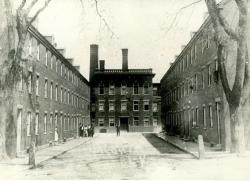
Laconia Mills boarding houses, Biddeford, ca. 1895
McArthur Public Library
Text by Renée DesRoberts, McArthur Library; Elizabeth De Wolfe, University of New England; and Marie O'Brien and Camille Smalley, Saco Museum
Images from Dyer Library Archives/Saco Museum, McArthur Library, Penobscot Marine Museum, and Maine Historical Society
Industry came early to Saco and Biddeford. The waterpower of the Saco River at the two cities lured a sawmill and iron forge in 1653.
Lumbering took off, with some 17 sawmills by 1800. Manufacturing began in 1811 when Colonel Thomas Cutts established the Saco Iron Works on Factory Island.
Metalworkers at the Iron Works used power machines to produce 3,500 pounds of nails per day.
The two cities began a long legacy of cotton manufacturing in 1825 when Saco Manufacturing built the largest textile mill in the country.
The story of the industrial rise and decline of Biddeford and Saco is one of manufacturing statistics and entrepreneurial successes. But it also is a story of the workers whose skill and knowledge helped build the industries -- and of the cultural and social growth of the cities on the Saco River.
Biddeford and Saco grew from small towns to booming urban areas. Daughters of Yankee farmers made up the first wave of mill employees. The mills made efforts -- not always successful -- to protect them and insure their good behavior. Nevertheless, the large numbers of young women essentially alone in newly urbanized areas created hazards for the women and concerns for the community.
By the middle of the nineteenth century, immigrants had started arriving from around the world, drawn by the jobs at the mills and related opportunities.
The mills and the services, industries, and culture that arose around them provide an important part of the history of the two communities.


