Henry, Frances, Charles and Ernest Longfellow, 1849
Item 28956 info
NPS, Longfellow House-Washington's Headquarters National Historic Site
Thousands of sketches, paintings, watercolors, and exercises in the Wadsworth-Longfellow family archives document that most family members also loved to draw.
Dozens of colored sketches composed by parent and child together illuminate their fascinating inter-generational efforts — art education at an intimate level.

Portrait of Papa, Henry Wadsworth Longfellow, ca. 1852
Item 15904 info
NPS, Longfellow House-Washington's Headquarters National Historic Site
The Longfellows’ artistic creativity did more than enrich their personal lives. Drawing was essential to the professional careers of several family members.
In addition, from their earliest years, Longfellow children all were encouraged to draw.
Here Edith, age six, sketches a portrait of her father, Henry W. Longfellow.

Mary King Longfellow at her easel, Boston, ca. 1885
Item 28955 info
NPS, Longfellow House-Washington's Headquarters National Historic Site
Mary King Longfellow, a Portland native and daughter of Henry’s younger brother, Alexander, was in the regular company of her cousins at Craigie House.
She began to draw at an early age and excelled as a watercolorist. This photograph shows her painting, surrounded by her work.

Peleg Wadsworth letter to son, 1796
Item 22473 info
Maine Historical Society
Education of the Wadsworths
Education became even more important to the Wadsworths, a typical upper-middle-class American family, following the Revolutionary War.
Henry's grandfather General Peleg Wadsworth recognized how critical a well-trained mind was in a country where individuals were self-governing.
On the second page of this letter, Wadsworth reported on the successful exercises of younger siblings, Henry (the poet’s namesake), George, and Lucia, all attending school in Portland.
He encouraged John to improve his public speaking, as “it is a very necessary Qualification in such a Government as ours.”

Elizabeth Wadsworth, Portland, 1801
Item 7276 info
Maine Historical Society
A Harvard College graduate, Wadsworth expected more of his children than proficiency in reading, writing, and arithmetic.
The study of Greek and Latin was as vital as public speaking and proper comportment. The general sought to instill in his children “the art and mystery of useful living.”
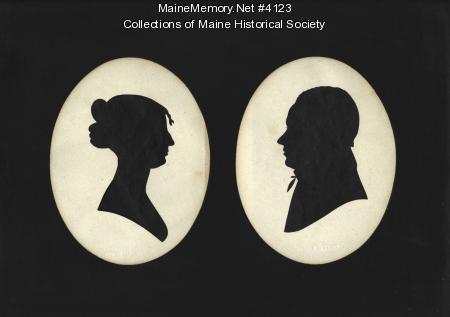
Silhouette of Zilpah and Stephen Longfellow, ca. 1805
Item 4123 info
Maine Historical Society
The Wadsworths patronized itinerant artists and early family portraits survive at the Wadsworth-Longfellow House.
William King, a well-known Salem silhouettist who visited Portland in 1805, cut several profiles for the Wadsworth-Longfellow family.
The profiles of Zilpah Wadsworth and Stephen Longfellow, the poet’s parents, were made the year after their marriage in 1804.

Zilpah Wadsworth sampler, Portland, 1786
Item 5545 info
Maine Historical Society
Teaching daughters to sew was viewed as an important way to prepare them for a productive and virtuous adulthood.
At an early age, girls practiced and perfected letters and numbers by working samplers with cross-stitching, a needlework that remains popular today.
Henry Wadsworth Longfellow's mother, Zilpha Wadsworth, worked this example when she was 11.

Map of the United States as drawn by Lucia Wadsworth, 1794
Item 7576 info
Maine Historical Society
Eleven-year-old Lucia Wadsworth signed and dated her assignment book, probably drawn for school.
Her maps of the world, based on published atlases, were carefully copied and colored by hand. The book also includes geometry exercises.

Unfinished silk pocket, Portland, ca. 1795
Item 22470 info
Maine Historical Society
Eliza Wadsworth began a silk pocket to hold small items, such as keys or sewing tools. She finely painted the design, including her initials.
Eliza also decorated a handkerchief with a neat pen-and-ink or stamped vine and stitched her name.
The family undoubtedly saved these small personal belongings as mementos of a cherished daughter who died at age 23.

Tricorn Hat Needlecase, ca. 1850
Item 11145 info
Maine Historical Society
The Wadsworth daughters cleverly crafted cases to hold needles and pins.
The small case, probably dating from the time that young Henry Wadsworth served as a lieutenant in the U.S. Navy, would have been a constant, patriotic reminder of the family’s service to country.

Ink sketch of Tripoli, 1804
Item 22474 info
Maine Historical Society
Henry Wadsworth at Tripoli
Peleg Wadsworth’s fourth son, Henry used his education toward a career in public service, joining the crew of the U.S.S. Constitution, the flagship of Commodore Edward Preble, a Portland native and Wadsworth neighbor.
In 1801, in its effort to protect free trade in the Mediterranean Sea, the United States flexed its naval might by beginning a blockade of Tripoli, one of four North African states that had controlled shipping by piracy and bribery for centuries.
In 1804 the U.S. Navy sent a squadron under Preble’s command to resolve this issue with the Barbary States.
Lieutenant Henry Wadsworth visited Algiers and Sicily, describing his activities and sketching the sights. His journal documents the nascent years of the U. S. Navy.
The Transit, a British merchantman, arrived in Malta in June 1803. He is believed to have sent the sketch of Tripoli, including the ruler’s fortified castle, to his sister Zilpah.

Battle of Tripoli, August 3, 1804
Item 13204 info
Maine Historical Society
This hand-colored print shows the Constitution at the right foreground, and thirteen other American gunboats in battle with boats defending Tripoli, the walled city in the background.
The text below the print reads: "The attack made on Tripoli on the 3d. August 1804 by the American Squadron under Comodore Edward Preble to whom this Plate is respectfully dedicated by his Obedient Servant John B. Guerrazzi 1. Constitution, Frigate 2. Sirion 3. Arges 4. Enterprise 5. Notlas 6. Vixon."
Henry died on September 4, 1804, when a bomb ship he and others manned to infiltrate and destroy the Tripolitan fleet exploded prematurely.
Three years later, Zilpah named her second son after him.

Commodore Preble pitcher, ca. 1805
Item 17014 info
Maine Historical Society
Subduing the Barbary Pirates, a great naval victory for the United States, was celebrated by a series of prints of the battle and of Commodore Preble.
The Attack Made on Tripoli was published expressly for the American market.
This pitcher made for Preble bears hand-painted heraldic arms and a scene of the attack, based on a printed source such as the one by Guerrazzi.

Alexander W. Longfellow, Portland, ca. 1825
Item 22491 info
Maine Historical Society
The Longfellow Children at School
In 1804 Zilpah Wadsworth married Stephen Longfellow, a Harvard-educated attorney.
In 1807 they took occupancy of her family’s home with their two small sons after the Wadsworths removed to their Hiram farm.
Six more children were born in the handsome brick house. The rhyme “Stephen and Henry / Elizabeth and Anne / Alex and Mary / Ellen and Sam,” recorded the children’s names and order of birth.
Patrons of the arts, the Longfellows were among the earliest supporters of Eastman Johnson, a Maine artist who later gained national success.
Henry Wadsworth Longfellow commissioned a number of portraits of his family and friends that still are on view at the Longfellow National Historic Site in Cambridge.

The First Maine State House, Portland, ca. 1832
Item 14660 info
Maine Historical Society and Maine State Museum
Henry’s childhood in Portland coincided with statehood for Maine in 1820. This rare watercolor documents Maine’s capitol, constructed in 1824.
It is the classical white building on the right next to the Cumberland County Courthouse.
Two blocks from the Wadsworth-Longfellow House, the Portland Academy, the red brick building to the left, was Henry’s school for eight years.

School report on Stephen and Henry Longfellow, 1817
Item 28960 info
Maine Historical Society
The Longfellow children were well educated. Stephen and Henry began their studies at ages five and three, respectively.
Elizabeth and Anne and their younger brother Alexander studied with Lucretia Frothingham.
Stephen and Henry studied with a number of different schoolmasters before entering Portland Academy in 1813.
That year Henry, age six, was “one of the best boys we have in school.”
His teachers often remarked on his “degree of diligence” and “amiable conduct.”
Henry completed his studies there in 1821 at the age of 14, continuing his education at Bowdoin College.
Zilpah Wadsworth sampler, Portland, 1786
Item 5545 info
Maine Historical Society
The girls drew and painted, but their father, following the advice of contemporaries on educating daughters, also wanted them to learn more useful subjects, such as arithmetic and “not just tend to their amusements.”

Anne Longfellow drawing, ca. 1818
Item 22471 info
Maine Historical Society
When work was done and there was free time, the children often turned to drawing. They drew from life and copied pictures from published books or magazines.
Anne drew this pencil and watercolor sketch of a room interior when she was about eight.

Lake George in 1833
Item 22467 info
Maine Historical Society
Copying prints published in a wide range of books and periodicals was part of the academic education of many young women and some young men during the early nineteenth century.
Henry Wadsworth Longfellow and his siblings all pursued drawing and other visual arts.

Drawing of St. Albans, England, 1822
Item 22468 info
Maine Historical Society
Ruins, such as these examples in the English towns of St. Albans and Kent, appealed to their romantic sensibilities.
On a cold January afternoon in 1833, Samuel, the youngest of Henry's siblings, “employed myself in drawing a picture” from Kenilworth, Sir Walter Scott’s novel set during the reign Queen Elizabeth.

Drawing of Lime Castle, 1822
Item 22469 info
Maine Historical Society
Signed “E W,” Lime Castle is attributed to Elizabeth or Ellen Longfellow, both of whom died of typhus.

St. Marguerite drawing, Portland, 1825
Item 22492 info
Maine Historical Society
St. Marguerite also is attributed to either Elizabeth (1808-1829) or Ellen (1818-1834) Longfellow.
Both were younger sisters of the poet, Henry Wadsworth Longfellow.

Garden sketch, Portland, ca. 1818
Item 22472 info
Maine Historical Society
Anne Longfellow (1810-1901) drew this sketch of a garden in about 1818.
This slideshow contains 23 items